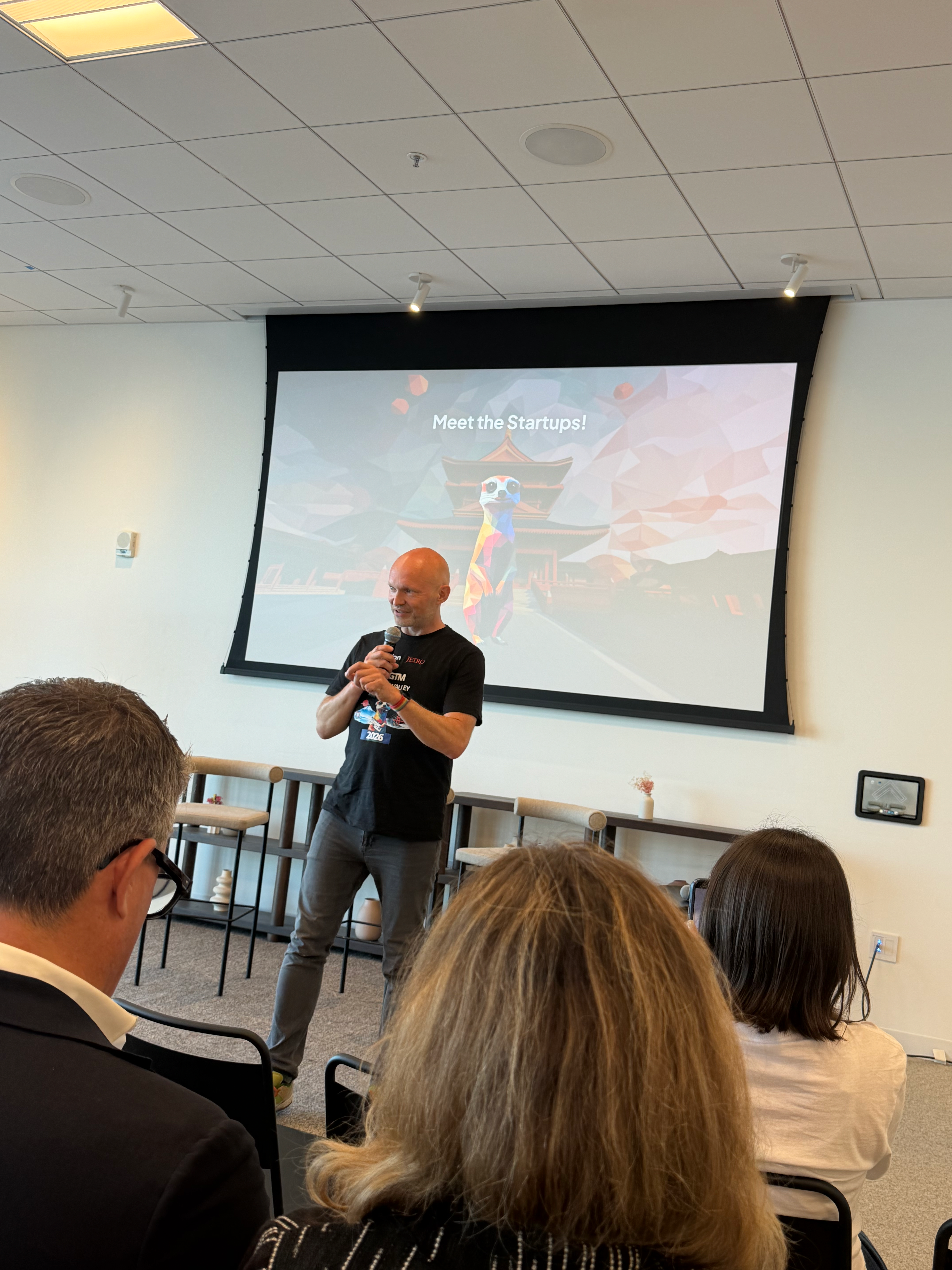
Panel Discussion
Cultural Differences & Challenges
- Japanese founders often struggle with English communication and team building when expanding to Silicon Valley
- Risk-averse culture remains in large Japanese enterprises, but the startup ecosystem is evolving with government support embracing a "no failures means you do nothing" mentality
- Speed of iteration is significantly faster in Silicon Valley — one founder noted building a product in two weeks in the US that took six months in Japan
- Customer feedback in the US is more direct and honest, while Japanese customers have very high expectations for product perfection
Key Success Factors for Japanese Founders in Silicon Valley
- Communication confidence is critical — founders need either strong English skills or a partner who can communicate effectively on their behalf
- Team composition matters more than individual credentials — balance between technical expertise and business/GTM skills is essential
- Speed and iteration — ability to gather feedback quickly, implement changes rapidly, and ask direct questions about what's not working
- Traction is often required, though some VCs invest pre-traction if the team shows right balance of technical and business mindset
Investment Perspectives
Manufacturing & Physical AI (Omni Ventures)
- Global dynamism thesis: manufacturing and innovation will be distributed globally, not centralized
- Japanese companies often struggle to scale domestically first, then globally — different from typical Silicon Valley SaaS playbook
- Physical AI and manufacturing require 100% product quality, unlike software's "ship at 70%" approach — makes Japanese precision mentality valuable
- Smaller markets can serve as "stepping stone customers" to iterate products before scaling to larger US market
- Access to established manufacturing infrastructure in Japan is valuable for US founders looking to scale hardware production
AI & Robotics (99BC)
- Focus on "physical AI" — intersection of AI and the physical world, combining atoms and bits
- Four Ts framework for evaluation: Tech (technical moat), TAM (large addressable market), Team (product shipping experience), and Traction (customer conversations)
- Key moats: proprietary data access for software, intellectual property for hardware
- Hardware requires precision and extensive coordination across design validation, engineering validation, and mass production
- Five-layer cake framework (Energy, Chips, Infrastructure, Models, Applications) — different countries excel at different layers, requiring global collaboration
Geography matters significantly for model building (access to proprietary data) and manufacturing (access to local factories and infrastructure). Different regions have advantages in different parts of the AI stack — collaboration across countries is essential.
Japan-Specific Opportunities
- Demographic challenges creating demand for AI agents and automation to replace human labor in white-collar and service sectors
- Legacy manufacturers need AI solutions for compliance and documentation when selling into US markets
- Strong operational expertise and production scaling capabilities make Japan attractive for hardware startups
- University and research lab adoption is easier in Japan as starting point before enterprise
Geographic Considerations
- Geography matters significantly for model building (access to proprietary data) and manufacturing (access to local factories and infrastructure)
- Different regions have advantages in different parts of the AI stack — collaboration across countries is essential
- Markets large enough to support an auto industry are typically large enough to produce significant companies, but global-first mindset is still important
Founder Insights
Manas Kala (Veritas AI — Research Intelligence Platform)
- Had to unlearn perfectionism from Japan — US adoption happens faster if solving real pain point, even at 95% accuracy
- PhD background is double-edged: some VCs dislike "academic founders" for being slow, but helps with founder-market fit and credibility
- Not having Japanese co-founder makes it harder to work with Japanese institutions and universities
- In US, can access top professors and researchers without introductions, unlike in Japan
- Customer conversations are critical: team follows rule of talking to at least one customer every day and doing one reverse demo daily
- US campaign generated 100 leads with 30 wanting to talk; in Japan, much harder to get meetings with heads of labs or industry PIs
Sales skills can be learned even if not innate — requires coaching, practice with lower-level customers, and continuous iteration on pitch. Partnerships and distribution channels are critical: a single partnership with a major company can transform $99 Shopify sales into $30M orders within 12 months.
Cultural Learning & Adaptation
- American-to-Japan cultural transition appears easier than reverse direction
- Partnerships and distribution channels are critical for scaling — single partnership with major company can transform $99 Shopify sales into $30M orders within 12 months
- Velocity, feedback loops, and distribution are the key moats for startups
JETRO Support
- JETRO supports both Japanese founders expanding globally and non-Japanese founders wanting to enter Japanese market
- Multiple programs available for matchmaking Japanese companies with foreign talent
- Actively welcomes Silicon Valley investors to visit Japan and explore opportunities
Startup Presentations
Five companies from the JETRO program presented:
Odyssey AI (Eric)
Building solutions for regulated sectors. Biggest learning: Speed and velocity of technology development in San Francisco far exceeds Tokyo, even as a city of 35 million.
Community Inclusion Platform (Yosuke)
Building platform with API for community inclusion. Surprised by how new AI trends feel even in San Francisco.
Supra (Ocean)
Platform agent for healthcare/pharmaceutical industry. Positioning as "electricity powering AI agent houses" — enabling safe deployment of many agents. Experiencing "movement of excitement" from rapid learning through founder and VC conversations.
Social AI (Christine & Declan)
Edutainment platform motivating students for standardized testing through online gaming. Learning how quickly one meeting leads to another in Silicon Valley, enabling rapid network building.
Legal Timesheet Solution (Matthias)
Former lawyer on three continents solving timesheet problem for legal profession. Biggest observation: Context building across continents confuses people elsewhere, but Silicon Valley immediately understands.
Event Format
- Panel discussion followed by networking session where attendees could meet the five startups at individual tables
- AI Salon format emphasizes human connection and honest feedback over formal pitching
- Startups encouraged to seek honest feedback, connections, and help beyond just funding